
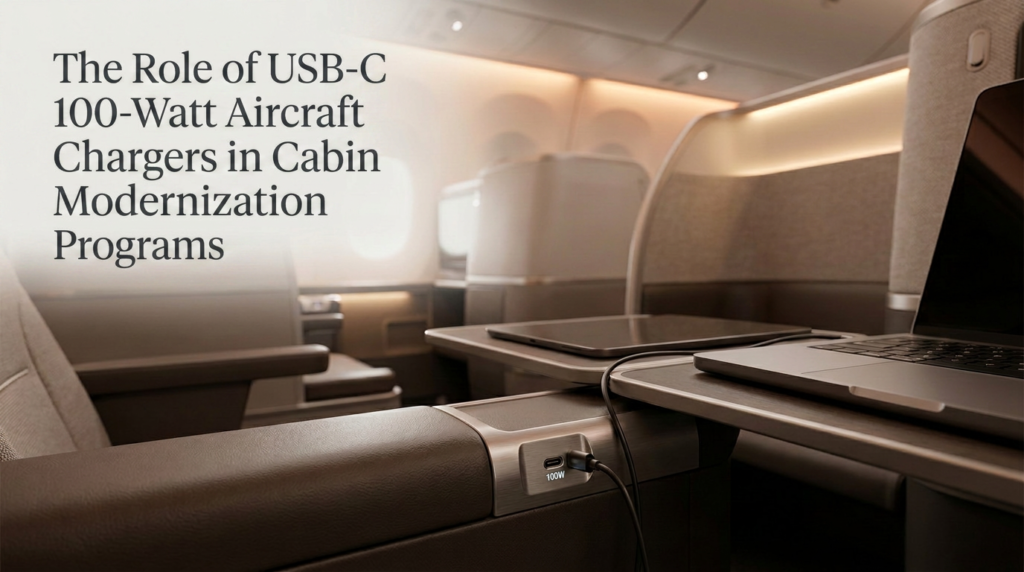
Quick answer: A USB-C 100-watt aircraft charger provides the power output needed to charge modern laptops, EFBs, and high-draw tablets at aircraft power speeds. For cabin modernization programs, it replaces multiple legacy ports with a single, intelligent solution that automatically adapts voltage output and meets DO-160G environmental standards.
Cabin modernization programs are one of the most active areas of investment in business and regional aviation right now. Operators are retrofitting interiors, completing center upgrades, and specifying new builds with a clear goal: match the connectivity experience passengers get everywhere else. The USB-C 100-watt aircraft charger has become central to that conversation, and for good reason.
At Aerospace Devices, we designed the SkyDock Pro USB-C specifically for this environment. This post covers what makes a certified 100W USB-C solution different from simply using a high-power consumer charger, and why the distinction matters when you are wiring a flight deck, a cabin seat position, or a mission crew station.
Why 100 Watts Matters for Modern Aircraft Cabins
The jump from USB-A to 100W USB-C is not just a speed upgrade. It is a change in what the port can support. A USB-A port at full output delivers around 12W. A 45W USB-C charger handles most tablet charging. But a laptop running active applications, particularly one connected to satellite comms or IFE, needs sustained power at 60W to 100W to charge properly while in use.
Pilots operating EFBs during long-haul legs, mission specialists running real-time mapping or communications software, and passengers keeping their laptops charged through a transatlantic flight all need a high-efficiency aircraft power supply that does not throttle or drop out under load.
The SkyDock Pro addresses this directly. It uses intelligent USB Power Delivery (PD) 2.0 and 3.0 technology to automatically negotiate the correct voltage with each connected device, supporting 5V, 9V, 12V, and 20V output profiles as required. The result is that the charger delivers exactly what each device needs, without the user having to manage anything.
Key Takeaways
- 100W USB-C output is the threshold needed to charge modern laptops at full speed during active use.
- USB-PD technology negotiates voltage automatically, meaning the same port serves phones, tablets, and laptops correctly.
- Legacy USB-A installations cannot be simply upgraded with an adapter; the underlying power architecture needs to change.
What DO-160G Certification Actually Means for Retrofits
When a completion center or MRO facility installs new electrical hardware, the certification trail matters significantly. DO-160G is the environmental testing standard that covers the conditions aircraft electronics must survive: vibration, shock, temperature extremes, humidity, altitude decompression, and electromagnetic interference.
The SkyDock Pro has been tested against DO-160G requirements, including decompression testing at 50,000 feet and vibration and shock qualification. For retrofit programs, this is not a nice-to-have. An uncertified high-power USB charger installed in an aircraft cabin creates a documentation gap that can complicate maintenance approvals, airworthiness directives, and resale.
Our customers include OEM completion centers and MRO facilities that require this kind of paper trail as standard practice. The SkyDock Pro supports that with available QTP and QTR documentation, making it compatible with regulated installation programs.
SkyDock Pro: Key Technical Specifications
| Specification | Single Port (SKD-505-00) | Dual Port (SKD-505-01) |
| Max Output Power | 100W (20V / 5A) | 100W per port |
| Input Voltage | 12VDC to 32VDC | 12VDC to 32VDC |
| USB PD Version | 2.0 / 3.0 | 2.0 / 3.0 |
| Efficiency | 90% to 93% | 90% to 93% |
| Certifications | DO-160G tested | DO-160G tested |
| Weight | 1.8 oz (52g) | Available on request |
| Dimensions | 1.5″W x 1.03″H x 1.25″D | Larger format |
| Environmental | Decompression to 50,000 ft | Decompression to 50,000 ft |
| Safety Features | OVP, UVP, OCP, OTP, short circuit, watchdog | Same |
Fixed-Wing and Rotorcraft: One Solution, Both Platforms
One of the practical advantages of the SkyDock Pro is that it is certified for both rotorcraft and fixed-wing aircraft USB applications. That matters for operators running mixed fleets, completion centers working across multiple aircraft types, and MRO facilities that want to standardize their parts inventory.
Rotorcraft environments are particularly demanding. Vibration profiles in helicopters differ substantially from fixed-wing turbulence loads, and installations near the firewall or in mission equipment bays face higher thermal stress. The SkyDock Pro’s CNC-machined aluminum housing, forced-PWM mode, and thermal shutdown with hysteresis are features that were specified with exactly these conditions in mind.
The soft-start circuitry also suppresses inrush current spikes during power-on, which reduces stress on the aircraft electrical bus and prevents nuisance trips on circuit protection devices, something completion engineers specifically look for when evaluating new electrical components.
Key Takeaways
- The SkyDock Pro is certified for both fixed-wing and rotorcraft installations, supporting fleet standardization.
- Soft-start circuitry and thermal shutdown protect the aircraft electrical bus and the charger under high-load conditions.
- DO-160G documentation, including QTP and QTR, is available to support regulated installation programs.
EU PED Compliance and Reducing E-Waste
The SkyDock Pro is fully compliant with EU PED (Portable Electronic Device) regulations, which is increasingly a baseline requirement for aircraft operating in European airspace. Beyond regulatory compliance, the design philosophy reflects a longer-term view: by supporting a wide range of devices through a single intelligent charging standard, the SkyDock Pro reduces the need for device-specific adapters and proprietary charging accessories.
Aerospace Devices notes that USB-C standardization contributes to preventing millions of pounds of e-waste annually by eliminating the cycle of incompatible chargers and cables. That is a meaningful outcome, and one that aligns with where the broader aviation industry is moving on sustainability.
For OEMs, completion centers, and operators evaluating cabin power upgrades, the SkyDock Pro is available as a single or dual-port unit. See the full specifications and ordering information.
Frequently Asked Questions
What makes a USB-C 100-watt aircraft charger different from a high-power consumer USB-C charger?
Certified aircraft chargers are designed to operate across a 12V to 32V DC input range, withstand vibration, temperature extremes, and altitude decompression, and include EMI shielding to protect avionics. Consumer chargers are built for stable 120V or 240V AC environments and have none of these qualifications.
Is the SkyDock Pro USB-C approved for both fixed-wing and rotorcraft installations?
Yes. The SkyDock Pro is certified for fixed-wing, flight deck, and rotorcraft applications. It carries DO-160G environmental qualification covering vibration, shock, decompression, and temperature extremes relevant to both platform types.
How does USB Power Delivery technology benefit aircraft cabin installations?
USB-PD allows a single port to intelligently negotiate the correct voltage for each connected device, from 5V for a phone to 20V for a laptop. This removes the need for multiple port types and simplifies the cabin electrical design while ensuring every device charges at its optimal rate.
What documentation is available for regulatory and MRO compliance?
Aerospace Devices provides qualification test procedures (QTP) and qualification test reports (QTR) for the SkyDock Pro upon request. The company also operates under ISO 9001 and AS9100-certified quality management systems, which support the documentation requirements of regulated installation programs.